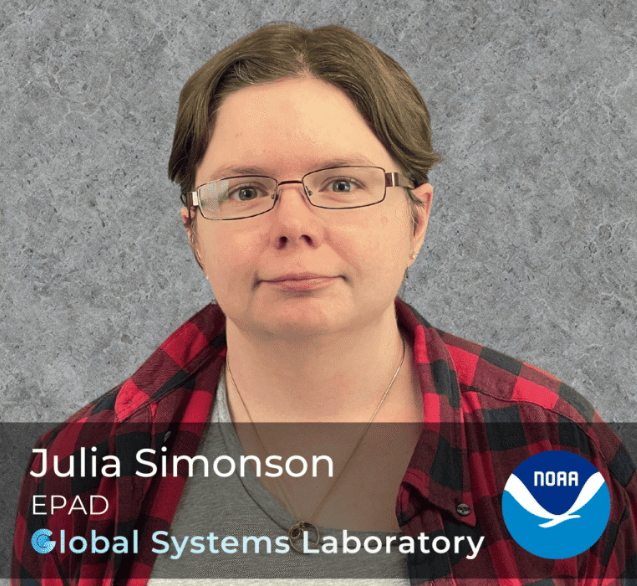
The latest PROUD award goes to Julia Simonson, a Research Scientist with CIRES and a NOAA Global Systems Laboratory (GSL) staff member who worked on the Unified Forecast System (UFS) Testing and Evaluation (T&E) project at the Developmental Testbed Center (DTC). Her research focuses on boundary-layer evolution and land-atmosphere interactions. Through her scientific contributions, initiative, and collaborative spirit, she has made a meaningful impact on the DTC and the broader UFS research community.
Julia has contributed to several major DTC efforts. These include physics testing and evaluation, RRFS benchmarking, and developing verification frameworks. Together, these efforts have significantly strengthened the DTC’s ability to systematically evaluate models and support research-to-operations (R2O) development.
Her colleagues recognize that Julia consistently seeks work beyond her assigned responsibilities. She has readily volunteered to help teammates collect and process high-frequency observational datasets, even when that work fell outside her own tasks. As part of the UFS physics T&E effort, she co-led the development of a Single Column Model (SCM) T&E framework. This framework makes it easier for the UFS physics community to configure and run SCM experiments and visualize their results, expanding the SCM’s value for collaborative physics testing and process-level evaluation.
Julia’s scientific curiosity and initiative have also created new avenues for analysis. She proposed investigating how changes to model physics affect the height of the marine boundary-layer inversion, providing the team with a process-based perspective for interpreting model changes. She then independently developed a stable-boundary-layer SCM case based on the GABLS2 field campaign. The resulting simulations have supported the SFS physics project.
Her contributions extend well beyond the DTC to the broader SCM developer community. Through discussions in the SCM GitHub repository, Julia helped advance conversations about the handling of RUC land-surface forcing. These discussions identified opportunities to improve the SCM’s representation of land-atmosphere interactions.
Colleagues also highlight Julia’s adaptability, clear communication, and collaborative spirit. During an analysis involving the smoothing of microwave profiler data, she asked thoughtful questions, carefully evaluated the methodology, and openly documented her approach. Her attention to detail ensured that the results were scientifically sound and reproducible.
Congratulations, Julia, on this well deserved recognition! Thank you for your scientific contributions, initiative, collaborative spirit, and generosity in supporting your colleagues and the broader DTC and UFS communities.